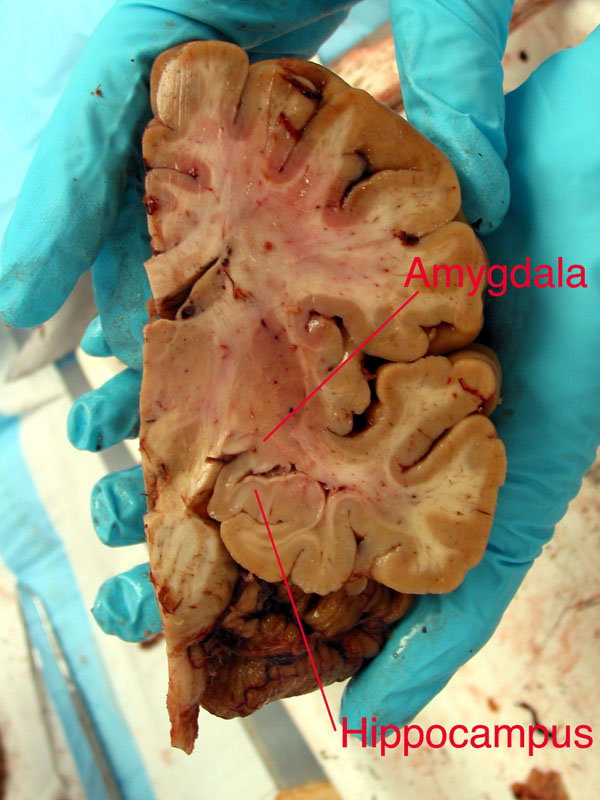
Knowing this organ in your brain can help you overcome fear forever -- Amygdala

What’s the antonym of Fear?

Finding the answer to this has been my obsession from the past few months. Shall we dissect this primal emotion and change our lives forever then?

As psychotherapists we generally find most of our clients suffer either from fear (phobia) or anger.
(of course with sadness as their underlying.)
(Now imagine a drum roll!!!)

Fear and Anger are the same!

(I was astounded on discovering this, you can mediate on this statement for a few moments…)

Knowing this was like unraveling the theory of relativity for me, where Einstein deducted the unity of space and time. Below are the priceless words which are much more valuable and gave me greater joy than what I could’ve got from finding a treasure of gold and diamonds.

“A variety of patients in a therapist’s office voice a dominant complain of painful aloneness, depression, sadness, and fear. Underneath these feelings is often the unacknowledged and pervasive anger.”
– Dr. Alice Givens

These words are pure gold isn’t it?

Now going a layer deeper,

Self-Preservation is at the epicentre of all our fears and anger.
Hence I wanted to explore fear in the light of neuroscience which holds “Amygdala” responsible for it.

The standard dictionary definition of Amygdala is as usual, quite confusing,

"The amygdala is one of two almond-shaped clusters of nuclei located deep and medially within the temporal lobes of the brain’s cerebrum in complex vertebrates, including humans. Shown to perform a primary role in the processing of memory, decision making, and emotional responses, the amygdalae are considered part of the limbic system.
Source.

Quiet simply its that part of the brain which is scanning for threats at all times :slight_smile:

We can see amygdala Click here to see it in MRI
Dissection

Amygdala is the organ in the limbic system (inner mind) —though a tiny little one is significantly responsible for our emotions which falls in the bracket of implicit memories.

Its study is important for us as

“The amygdala has been implicated in many diseases, such as depression 3), sleep debt and anger 4), as well as other neuropsychiatric diseases."
Source.

Though the amygdala and hippocampus comprise the limbic system. Below is a screenshot of the difference between them based on their functionality .

Take a breath now!
Don’t get overwhelmed.
So far we saw that fear and anger are the primary issues clients come to us for and in the light of neuroscience, we experience fear due to the amygdala’s activation.

Patients with abnormal amygdala do not experience emotions or have implicit memories!

Weather we are really in a life threating situation or perceiving one to be (thanks to the projection capability of mind – Adhyasa) our body has already started pumping all the stress related hormones into the blood stream.

For example, when you imagine binging on your favourite dish, the unconscious mind triggers the production of saliva in the mouth.

As the unconscious mind or the inner mind or the subconscious mind or the limbic system doesn’t care about what is “real”. That activity of ascertaining reality has been outsourced to the conscious mind which accomplices it with its accomplice–the five senses.

So the bottom line is that what we imagine is also as real to the subconscious as anything tangible. Like a thought of a snake is as good or sometimes more fearful than the snake itself!

Which is why there is so much of emphasis on positive thinking. Like a thorn can be used to remove another thorn. We can use the power of imagination and assertion to program ourselves to “Trust” ourselves, our capabilities or a higher force to reduce the activation of amygdala.

“Trust and fear are inversely related; fear activates the amygdala and trust decreases activation.”

So this is the secret, take care of not getting your amygdala activated through the day. Train yourself to be in the now, look at situations as they are. Ask yourself this question when you experience fear,

What is it that I can trust now but I am not ?

Share it and also comment below on how you handle stress or fear on a day to day basis!

Dear Venu,

A very useful article, grateful to you for bringing insights into our lives for contemplation :pray:.

If I have understood correctly from the Bhagwat Gita, Chapter 4 Verse10 says that Attachment is the cause of both fear and anger.
Root cause being Attachment to Self or anything else.

As you have suggested, we should ask the question " What is it that I can trust now but I an not?".

AMYGDALA… That’s food for thought and I’m churning it :slightly_smiling_face:!

Love & Light,
ReikiNanda
8147593011

Came across an article recently that was titled “Our 3 brains - Why 95% of Our Behaviors Are Not Conscious (Extended Review)” which in turn reminded me of this post by Venu on Amygdala!

Here is a book “BWRT: Reboot your life with BrainWorking Recursive Therapy” by Terence Watts that presents an interesting methodology to manage amygdala attacks. The methodology outlined in the book helped me to significantly reduce the frequency of freeze modes that I would get into!

It’s pure gold! Often tiny things are not really as tiny as they seem! See this tiny thing if not taken care of, can create so many problems!
For managing day to day stress and fear what I do is:
1.Meditation
2.Water therapy
3.Few Mind reprograming tools and techniques.
4.Listen / Say affirmations
5.Be with positive people
:slightly_smiling_face: :slightly_smiling_face:

What are the few mind reprogramming tools and techniques that you use? @shiprabharadwaj13

Yes Murlidhar ji !

I use tools & techniques like :

  1. Tapping Technique
    2.Present moment meditation technique
  2. Circle technique
  3. Listening night affirmations to reprogram mind to name a few

There are many other techniques as well
( its a full course i even also offer to my clients for healing)

:blush::blush:

@venu Sir, another gem from your treasure :folded_hands:t2: So thoughtful! I feel how we meet fear and restlessness each day shapes the path. What we do not soothe through remembrance, the soul tries to quiet through attachment. But when stress is met with surrender, the heart learns again where it truly belongs. :folded_hands:t2:

this article in the newspaper brought my memories up of the beautiful guidance from our Beloved Dr Venu.

very well my beloved Col. @Monesh_Bathre
to think of it, the basic needs to the caveman are the same of the basic needs of modern man :slight_smile: And as along as these are there, we will be battling the same issues of survival, previously it was in the cave, now in an apartment :slight_smile:

Respected Venu sir, reading this​:folded_hands: made me pause and reflect.:folded_hands:

I completely agree that fear is one of the biggest reasons people seek therapy and yes, our brain is constantly trying to protect us, but understanding the amygdala has helped me explain many reactions to clients in a very simple way.

At the same time, I feel there are a few places where I see things a little differently.

For eg. I don’t think fear and anger are exactly the same emotion.

In my experience anger is often one possible expression of fear, but not the only one.

I have worked with clients who responded to fear by becoming angry and controlling. But I have also worked with equally fearful clients who became people pleasers, froze completely, remained silent for years, developed anxiety, IBS, migraines, autoimmune conditions or simply withdrew from life. The fear underneath was the same, but the expressions were very different.

Even in nature we see this. If two animals feel threatened, one attacks while another runs away. The threat is the same, the nervous system chooses a different survival strategy.

From a neuroscience perspective too, the amygdala is certainly important, but it isn’t working alone.

The hippocampus gives context to memories, the prefrontal cortex helps us evaluate reality, the insula processes bodily sensations and many other brain networks participate.

Human emotions are beautifully complex.

One thing which really resonate with me is the statement

'imagination can trigger real physiological responses’.

We all see this every day in hypnosis, guided imagery, placebo effects and even anticipatory anxiety.

A person merely imagining a frightening event can experience palpitations, sweating or breathlessness. Equally, imagining safety can calm the body. This is incredibly powerful.

Sometimes fear is not just about the brain. At times it comes from deep conditioning (samskaras), unresolved emotional memories, attachment, identification with the ego and occasionally experiences that clients subjectively experience during regression work.

Whether we interpret these literally or symbolically, healing often happens when awareness replaces unconscious reaction.

For me, trust is certainly a beautiful antidote to fear. But I would probably replace the word “trust” with “awareness.” Because awareness gives birth to trust.

When I become aware that I am not my thoughts, not every emotion, not every fearful prediction, something naturally relaxes. Trust follows…

In the Bhagavad Gita too, Shri Krishna repeatedly reminds Arjuna not simply to “trust,” but first to see clearly to know his true nature beyond the fearful mind.

Fear begins to dissolve as wisdom grows.

So perhaps for me the journey looks like…

Awareness → Understanding → Acceptance → Trust → Courage.

Thank you Venu Sir again for sharing such a thought-provoking resource. It has certainly given me another perspective and I enjoyed reflecting on it. :folded_hands:

With due respect Venu sir,

The above valuable resource says that discovering "fear and anger are the same" is like Einstein discovering the unity of space and time.

I feel this is actually a metaphor and not a scientific comparison.

What Einstein discovered was that space and time are not separate things.

Before Einstein…

Space = where things happen.

Time = when things happen.

Einstein showed that they are woven together into a single fabric called space-time.

Like…Imagine watching a cricket match.

We cannot describe Virat Kohli hitting a six by only saying

“It happened at Wankhede Stadium.”

or only saying

“It happened at 5:15 pm.”

We need both where and when.

Space and time are inseparable.

Similarly,

"Fear and anger may be two expressions of one underlying survival mechanism."

It is a beautiful analogy, but it is not an equivalent scientific discovery.

Like think of the amygdala as brain’s security alarm system.

Its main job is one question,

“Am I safe?”

Every second it scans

faces…

voices…

body language…

sounds…

memories…

surroundings…

looking for possible danger.

When it senses danger, even before we are consciously aware it activates the body’s survival response.

It signals adrenal glands, autonomic nervous system, stress hormones…

This leads to–

faster heartbeat…

rapid breathing…

sweating…

muscle tension…

heightened attention…

before we even “decide” to be afraid.

Let me give real-life example

You are walking in dim light.

You suddenly see something long and black.

Immediately

heart races…

body jumps…

Then you look carefully.

It’s just a rope.

Who reacted first?–The amygdala.

Who corrected the mistake?–The prefrontal cortex.

The amygdala prefers making false alarms rather than missing a real snake.

Evolution says

Better to mistake a rope for a snake than a snake for a rope.:cowboy_hat_face::cowboy_hat_face:

Is the amygdala only for fear?
No.
Modern neuroscience shows the amygdala helps process
fear, anger, threat, reward, emotional learning, social signals and emotional salience.
It is better described as an emotional relevance detector rather than the fear center.

“Patients with abnormal amygdala do not experience emotions.”

This statement is too absolute.

I feel it is not completely accurate.

People with severe bilateral amygdala damage still experience many emotions.

They can feel,

happiness…

sadness…

love…

surprise…

But they especially struggle with

fear recognition, fear learning,

recognising fearful facial expressions,

responding appropriately to danger.

One famous patient, known in neuroscience as S.M.( SM-046 ) had nearly complete destruction of both amygdalae.

Interestingly, she reported very little fear.

Researchers exposed her to haunted houses…snakes…spiders etc.

Most people panic. She became curious. However…

She could still laugh.

She could feel affection.

She could become frustrated.

So emotions did not disappear.

Only certain emotional processes were profoundly altered.

"Patients with abnormal amygdala do not have implicit memories."

Again, this is an oversimplification.

Implicit memory means,

learning without consciously remembering.

egs. riding a bicycle…

typing…

emotional conditioning…

habits…etc.

The amygdala is involved mainly in

emotional implicit memories especially fear conditioning.

Let me explain,

Suppose a dog bit you at age five.

Years later,

another dog approaches.

Your heart races before your conscious mind remembers the childhood incident.

This emotional learning involves the amygdala.

But if the amygdala is damaged,

other kinds of implicit memories still exist.

You can still

learn motor skills…

develop habits…

improve at puzzles…

because these depend on other brain systems like the cerebellum and basal ganglia.

So it would be more accurate to say:

Severe amygdala damage mainly impairs fear-related emotional learning, not all implicit memory.

From a Vedic perspective too, the amygdala is not the source of fear, it is one instrument through which fear is expressed.

The deeper source lies in the conditioned mind (चित्त ) carrying samskaras and vasanas.

The brain is like a musical instrument.

The mind plays the music.

The soul is the witness.

A fearful samskara may activate the nervous system, including the amygdala.

Conversely, through meditation, self-inquiry, devotion, breathwork and repeated experiences of safety, those conditioned responses can soften.

Studies have even shown that practices like mindfulness can reduce excessive amygdala reactivity over time.

So neuroscience explains how fear is processed in the brain, while spirituality explores why fear arises at a deeper level and how identification with the true Self can gradually free us from it.

In this sense, the article’s central message, that cultivating trust and awareness can reduce unnecessary fear is valuable. The main caveat is that some of its neuroscience statements should not be taken as literal scientific facts.

agreed Supu @kobrakulsh
thanks for the correction :folded_hands:

@kobrakulsh Hi Mam

Can you.please help with best way to avoid this.

I agree its better not to miss a threat but if mind start treating every rope as snake, life becomes hell. So please suggest the best way to avoid these unknown fears and live a normal life :slight_smile:

Hi Vikrant. :blush:

A very good question.

Personally, I don’t think we should try to stop the amygdala from doing its job. It’s actually there to protect us. The real challenge is teaching our mind the difference between a real danger and an old fear.

Whenever I notice fear, I ask myself just one simple question…

“Is there really a snake in front of me… or is my mind remembering an old snake?” :blush:

( अब वो बात अलग है कि मुझे सांप से बिलकुल डर नहीं लगता :cowboy_hat_face::wink::rofl:)

Many a times, I realise it is the second one. So, just pausing, taking a few slow breaths and looking at the situation as it is, not as our past is telling us, can make a huge difference.

If the same fear keeps coming again and again, it usually means there’s an old emotional wound asking to be healed, not another danger waiting to happen.

In therapy also I have often seen that fear is like a child who got scared once and now thinks the same thing will happen every time. The child doesn’t need to be scolded… it just needs to know,

"You’re safe now."

Maybe we all need to remind ourselves of that once in a while. :heart:

And the mind slowly learns that today is different from yesterday… and little by little, every rope stops looking like a snake. :folded_hands::blush:

For me, awareness is the first step. The moment we become aware that it’s an old fear and not today’s reality, the fear already starts losing its grip.

Just my thoughts. :folded_hands::blush: